

DENTAL IMPLANT
Permanently restore the natural function and appearance of your mouth
Have you recently found yourself with a missing tooth and wondering what your options are? Did you know that dental implants are a durable replacement solution that fits naturally into your jawbone? This blog will answer all your questions about dental implants, from the installation process to daily maintenance.
One of the key points in the success of an implant is the experience and skill of the dental surgeons.
The arrival on the market of low-cost clinics or very aggressive dental tourism proposals should alert you to the long-term quality. In fact, an implant must be able to last a lifetime! If certain savings are made at the time of installation, the final cost will ultimately be higher and the hassle too. In particular, very cheap implants can only be repaired in the clinic that installed them!
So, make the right choices and prepare to find your most beautiful smile!
Key takeaways
- A dental implant is an artificial root that replaces a missing tooth. It inserts into the jawbone to provide a solid dental anchor.
- Dental implants are more comfortable than removable dentures or dental bridges. They look and feel like real teeth.
- The installation of a dental implant is done in several stages: evaluation, implantation surgery, healing phase and installation of the dental prosthesis.
- The skill and experience of the dental surgeon is fundamental
What is a dental implant?
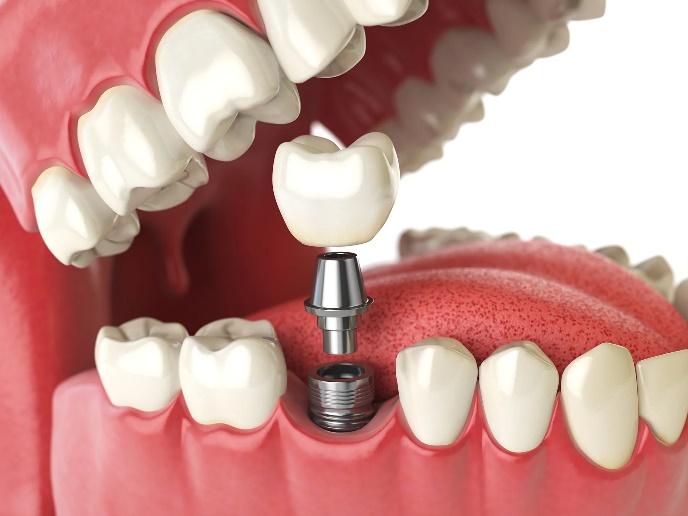
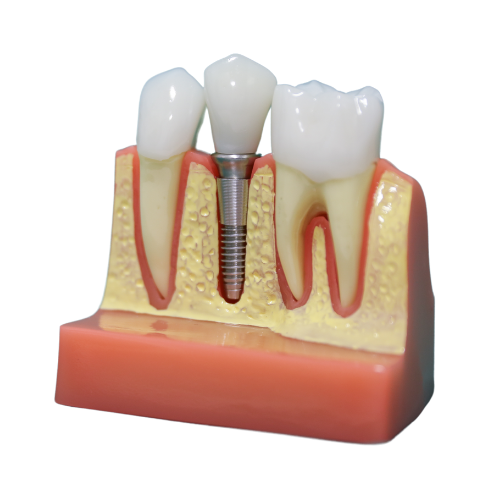
A dental implant is a medical device that replaces a missing tooth root. It works by acting as an artificial root, anchored resiliently into the jawbone.
Compared to other tooth replacement solutions, such as dental bridges or removable prostheses, the implant offers several advantages. It looks and feels more natural, and can help maintain the health and integrity of your jaw.
There are different types of dental implants, including titanium, zirconium or polymer. Which option you prefer will depend on your individual oral health situation.
What is a dental implant?
A dental implant is a medical device that replaces a missing tooth root. It works by acting as an artificial root, anchored resiliently into the jawbone.
Compared to other tooth replacement solutions, such as dental bridges or removable prostheses, the implant offers several advantages. It looks and feels more natural, and can help maintain the health and integrity of your jaw.
There are different types of dental implants, including titanium, zirconium or polymer. Which option you prefer will depend on your individual oral health situation.
Definition and operation
A dental implant is an artificial root that replaces a missing natural tooth.
This medical device serves as the basis for a crown, bridge or dental prosthesis. After implant surgery, the healing time varies according to each patient, but it is necessary for the implant to integrate perfectly with the jawbone.
Once this integration is successful, the dentist places the prosthesis to restore the mouth to its natural and functional appearance.
Advantages over other tooth replacement options
A dental implant provides you with much greater comfort than removable prostheses or dental bridges. Once in place, it functions like a natural tooth, meaning you can eat, speak and smile without any discomfort.
Compared to dentures or bridges which must be replaced often, dental implants have an impressive longevity when they are well maintained.
Additionally, unlike other tooth replacement options, the dental implant does not need to rely on neighboring teeth for anchorage. This preserves the health of your other teeth by eliminating the need to weaken them to attach a bridge.
The bone healing process around the implant also helps maintain the shape and density of your jawbone, preventing its breakdown over time.
The different parts that make up a dental implant
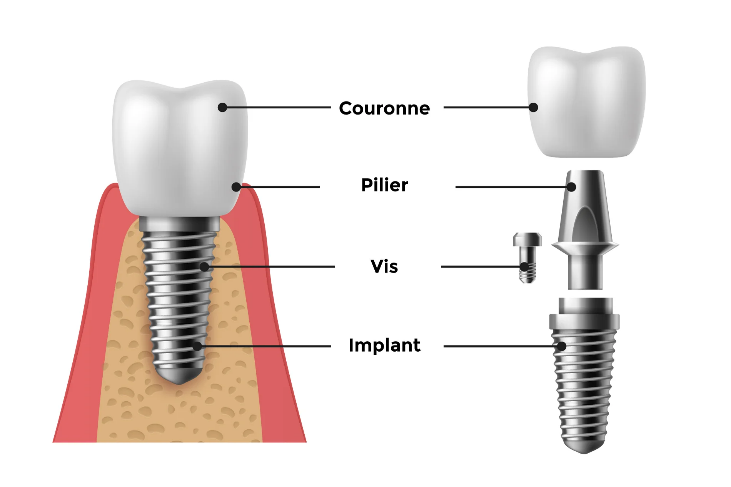
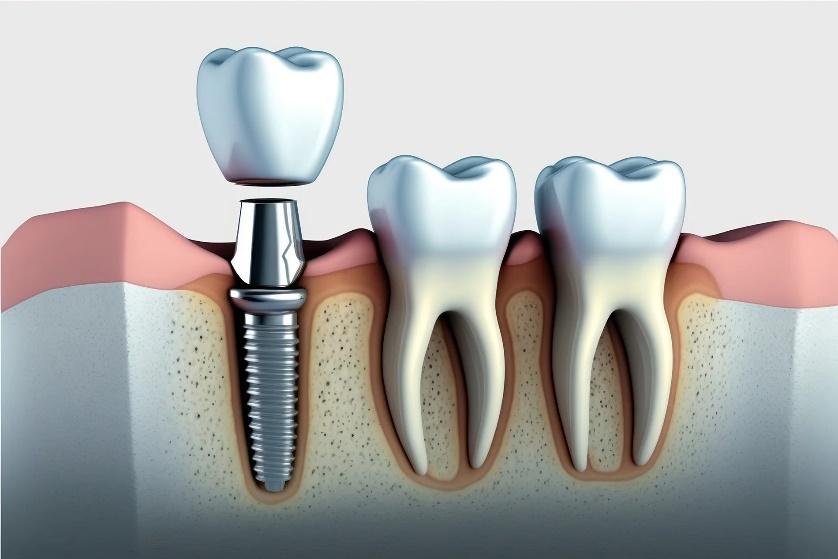
A dental implant is a complex device made up of several essential parts that work together to replace a missing tooth.
The implant :
The first component is the implant screw, usually made of titanium due to its biocompatibility. This screw serves as an artificial root and is carefully inserted into the jawbone, where it will fuse with the surrounding bone in a process called osseointegration.
Pillar:
Next comes the abutment, a piece that is attached to the implant screw and serves as the base for the crown. It is the abutment that ensures the transition between the implant buried in the bone and the crown visible in the mouth.
Crown :
Finally, the crown is the visible prosthetic part that looks and functions like a natural tooth. It is usually made from materials like ceramic or zirconium to ensure both durability and aesthetics.
Attaching the crown:
After the crown is made (which can take a few days to a few weeks depending on the method used), the dentist will attach it to the abutment. There are several methods for attaching the crown to the abutment:
The different parts that make up a dental implant
A dental implant is a complex device made up of several essential parts that work together to replace a missing tooth.
The implant :
The first component is the implant screw, usually made of titanium due to its biocompatibility. This screw serves as an artificial root and is carefully inserted into the jawbone, where it will fuse with the surrounding bone in a process called osseointegration.
Pillar:
Next comes the abutment, a piece that is attached to the implant screw and serves as the base for the crown. It is the abutment that ensures the transition between the implant buried in the bone and the crown visible in the mouth.
Crown :
Finally, the crown is the visible prosthetic part that looks and functions like a natural tooth. It is usually made from materials like ceramic or zirconium to ensure both durability and aesthetics.
Attaching the crown:
After the crown is made (which can take a few days to a few weeks depending on the method used), the dentist will attach it to the abutment. There are several methods for attaching the crown to the abutment:
Process of placing a dental implant
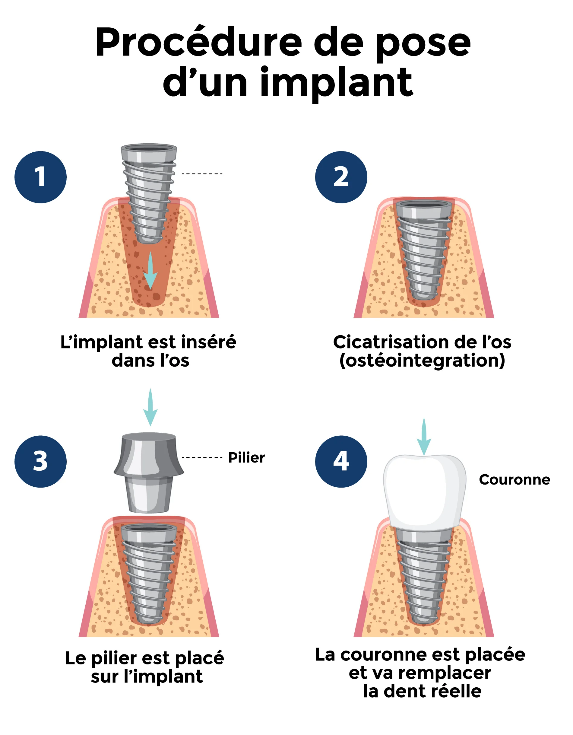
The dental implant procedure begins with a thorough assessment and careful planning. Implantation surgery is then performed, during which a titanium screw, zirconium screw or polymer implant is inserted into the jaw bone.
After the operation, a healing and integration phase of the implant is necessary to ensure solid anchoring. Finally, the denture is attached to the implant, completing the process.
Assessment and planning
Before a dental implant is placed, your dentist will perform a detailed assessment of your oral health. This step is essential to determine if you are a good candidate for this procedure.
The dentist will examine your jawbone to check that there is enough bone for the implant to anchor. He will also take into account your general health, your medical history and the quality of your remaining teeth.
Computed tomography (CT) or cone beam scanner
These three-dimensional images provide a detailed view of bone density and allow precise visualization of anatomical structures, such as nerves and sinuses. They are essential for planning precise implant placement and determining whether additional procedures, such as bone grafting, are necessary.
The treatment plan, including the type of implant to be used – titanium screw, zirconium screw or polymer implant – is also established during this phase.
Implantation surgery Implantology
Implantation surgery is a crucial step in the dental implant process.
- The dental surgeon begins with local anesthesia to minimize any pain during the procedure.
- Then, he makes a small incision in the gum where the tooth is missing.
- It drills a hole in the jaw bone to accommodate the dental implant.
- The titanium, zirconium screw or polymer implant is then inserted into this hole. It is the artificial root which serves as an anchor for the future dental prosthesis.
- After this operation, the healing time required depends on the patient and their ability to heal is 3 to 6 months.
- During this bone healing phase, you must avoid certain bad habits such as smoking which can slow down the healing process.
Stacked Surgical Guidance….
What is a Stacked Surgical Guide?
At its core, a stacked surgical guide is a device used during dental implant surgery. This guide is designed to fit a patient’s dental arch and features precisely designed sleeves or guides that determine the angle, depth and position of the implant to be placed. By using these guides, dental surgeons can ensure that implants are optimally positioned, which is crucial for the longevity and functionality of the implant.
Navident Digital Guidance
The guidance allows the surgeon to follow the placement of the implant in real time and on 3D images, and will guide him for greater precision. In practice, it is enough to carry out a pre-operative scan, and place markers, to follow the procedure in 3 D and in real time. We use the Navident technique which is dynamic guidance, which allows us to modify the procedure during the intervention if necessary.
Implant healing and integration phase
The integration of your new dental implant requires a healing phase. Here’s how it usually happens:
- After surgery, your jaw bone should heal around the implant. This process is called osseointegration.
- During this time, you may experience some level of pain and discomfort.
- It is recommended to avoid any intense physical exertion during the first days.
- Complete healing and integration of the implant may take several months.
- It is recommended to have a gentle diet for a few weeks so as not to disrupt the healing process.
- Pain medication will be prescribed if necessary to manage discomfort after surgery.
- During this time, it is crucial to avoid tobacco and alcohol which can interfere with healing.
- Good oral hygiene protects your new implant from infections while it heals.
- Finally, post-operative visits to your dentist are planned to monitor your recovery and make sure everything is going as planned.
Fitting the dental prosthesis
Fitting the dental prosthesis is a key step in the implantology process. Here’s what you need to know:
- The custom-made dental prosthesis is attached to the implant.
- This connection creates a strong anchor for the new tooth.
- The prosthesis can be a dental crown, a dental bridge or a removable prosthesis.
- The choice of denture depends on several factors, including the location of the missing teeth and your overall oral health.
- Once fitted, the prosthesis looks and functions like a real tooth.
- We must take care of this new structure as we would other teeth: by regular brushing and flossing.
- Visits to the dentist should not be neglected; they are essential to ensure that everything functions correctly after implant placement.
- Bad habits like grinding your teeth or chewing on objects can damage the denture.
Conclusion
The dental implant offers a durable and reliable alternative to replace missing teeth. Very similar to natural teeth, they provide comfort and confidence to those who wear them.
With proper care, these implants can last a lifetime. Choose health and a smile with dental implants.
Today, installing dental implants is a simple procedure that should not scare you. It is important to trust a competent team with extensive experience in implant placement.